
Connecticut DOC Release System
Connecticut Department of Correction is a statewide jail and prison system, not one detention building. The DOC FAQ says the state’s 18 correctional facilities include both jails for pretrial offenders and prisons for sentenced offenders. This structure is central to Milford release research. There is no operating county sheriff system that publishes a Milford jail roster. Anyone committed to state custody is tracked through CT DOC regardless of where the person is placed.
A Milford case may begin at the police department, pass through court, and enter DOC under a mittimus, which is a court commitment order. Placement can change with classification, bond, court action, sentence, program needs, or release planning. The public search follows the person’s DOC record rather than a single local building. That is why the statewide system is the correct context for state custody.
| Custody stage | Primary source |
|---|---|
| Milford police only | Police record and Judicial Branch docket |
| State pretrial custody | CT DOC search, bond field, court docket |
| Sentenced state custody | DOC sentence and release-date fields |
| Community supervision | DOC status, BOPP, Parole and Community Services |
| Federal or ICE custody | Separate federal locator |
Find Connecticut DOC Releases
The CT DOC inmate information search is the first public source for a named person who entered state custody. Its instruction is specific: enter only the inmate number or only the first few letters of the last name for better results. Use the inmate number when it is available in court papers, prior correspondence, or an earlier custody result. A name search should be checked against date of birth and other identifiers.
- Decide whether the case actually entered CT DOC custody.
- Search by inmate number or a short last-name prefix.
- Open the matching record and compare identifying fields.
- Review location, status, bond, sentence, and release-date entries.
- Check the court docket for the legal event behind the status.
- Contact Public Information if the public result is stale or incomplete.
A released person may not appear in a current-custody view in the way a housed person does. Look for status, former location, correctional history, and dated entries. The Milford release search hub gives the local police and federal alternatives when the DOC search is the wrong system.
Connecticut DOC Release Fields
DOC’s Management Information Systems Unit says the public search is fed from the Offender Based Information System, or OBIS. OBIS covers inmates from initial intake through eventual release to the public. The public field set makes it possible to separate pretrial custody from a sentenced release, though not every field appears or applies in each record.
| Field | Release use |
|---|---|
| Inmate number and name | Identify the matching DOC record |
| Latest admission date | Place the current custody episode in time |
| Current location and status | Distinguish facility placement, transfer, and release status |
| Bond amount | Useful for an accused or pretrial person |
| Controlling offense | Shows the offense controlling the DOC record |
| Maximum sentence | States the sentence ceiling in the system |
| Maximum and estimated release dates | Show different sentence and planning dates |
| Special parole date | Signals a possible community-supervision stage |
| Detainer information | Warns that another authority may affect release |
The DOC FAQ also identifies minimum release date, photograph, correctional history, and disciplinary history where applicable. For a pretrial person, bond and location may matter most. For a sentenced person, sentence, release dates, special parole, and detainers are more useful. The official term “estimated release date” should not be called a fixed date.
Connecticut DOC Data Timing
The MIS Unit says a nightly data feed moves OBIS information into the public inmate search. The inmate information page describes daily updates and warns that a person’s status can change quickly. Both facts matter. A release or transfer may occur before the public result changes, and a result that was accurate yesterday may not answer an urgent question today.
Use the online record as strong public evidence, then verify time-sensitive facts. CT DOC Public Information can address further offender-information questions. CT SAVIN can send covered event notices. The court docket can show bond, sentencing, or discharge activity. No official DOC source identified in the research publishes a rolling Milford 24-hour or 72-hour release feed.
The official DOC inmate information page gives the update cautions and public contact. Its captured page appears below.
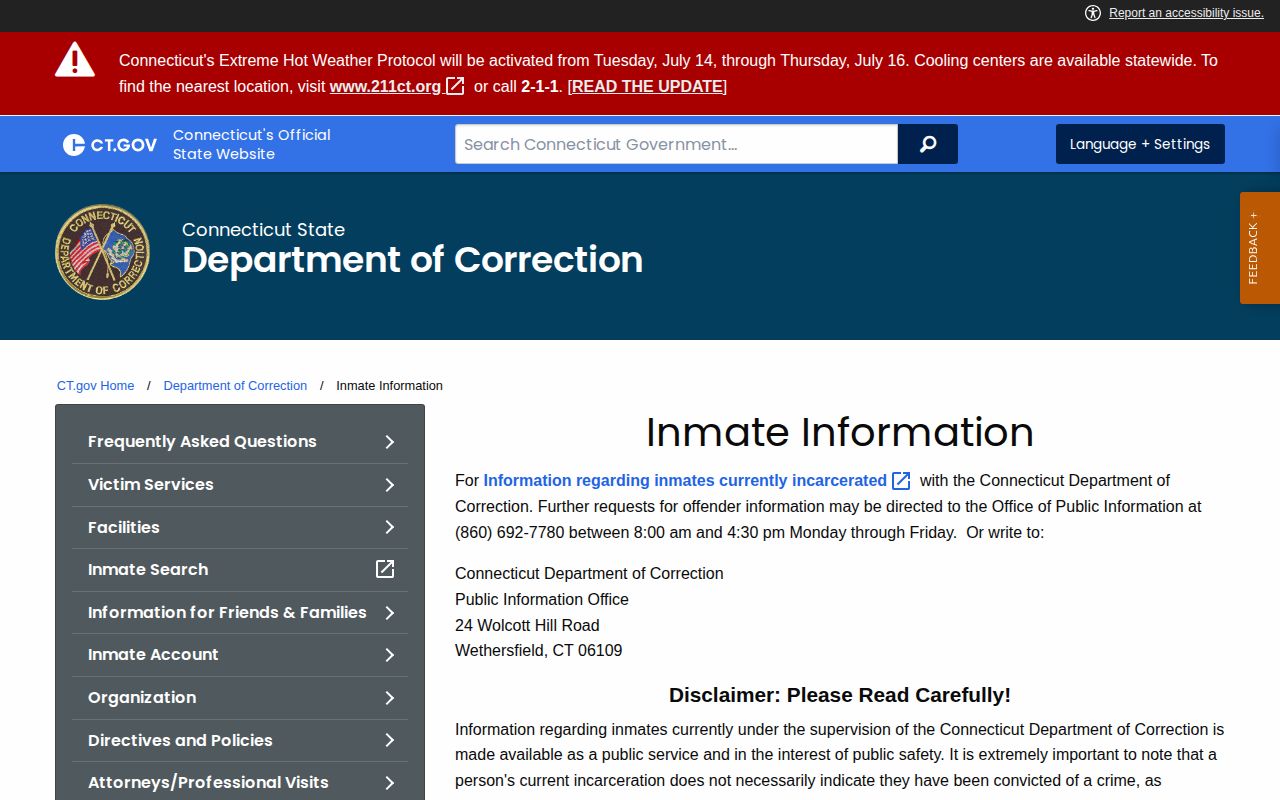
The warning supports a two-source check when location or release status has just changed.
Connecticut DOC Record Contacts
The Public Information Office is the records route when a public result does not supply enough context. Its inmate information page lists telephone service from 8:00 a.m. to 4:30 p.m., Monday through Friday. The MIS page gives DOC.PIO@ct.gov as a common public contact. A request should name the person, inmate number if known, the Milford case or docket if useful, and the exact release or custody field being sought.
CT DOC Public Information
24 Wolcott Hill Road
Wethersfield, CT 06109
Phone: 860-692-7780
Email: DOC.PIO@ct.gov
Hours: 8:00 a.m. to 4:30 p.m., Monday through Friday
A single-person release inquiry is not the same as a request for a mainframe dataset. CT DOC states that aggregated data requests use a separate process and are not FOI requests. Keep the inquiry focused on the maintained offender information or release record needed for a specific custody question.
Connecticut DOC Release Dates
Connecticut uses several dates because they answer different questions. The minimum date can mark an early sentence threshold. The maximum release date reflects the outer sentence date in the record. The estimated release date is the public field closest to a projected release. A special parole date concerns a supervision stage. None should be read without the status, sentence, and detainer fields.
Earned risk reduction credit under C.G.S. § 18-98e may allow eligible sentenced inmates to earn up to five days per month at the commissioner’s discretion. Credits depend on the offender accountability plan, eligible programs and activity, and conduct. They can be lost and cannot reduce a mandatory minimum. Presentence confinement credit under § 18-98d can also affect calculation.
Parole eligibility is not the estimated release date. BOPP says many eligible definite sentences of at least two years and one day reach ordinary review after at least 50 percent, less applicable jail or risk reduction credits. Certain physical-force offenses use an 85 percent threshold, and post-July 1, 2013 RREC does not reduce that 85 percent eligibility date. Eligibility permits review. It does not promise release.
Connecticut DOC Release Supervision
Release from a prison building can still leave a person under correctional authority. Parole is a Board-authorized conditional release. Special parole is a court-imposed term after incarceration. Transitional or community placement may move a person out of a secure facility while DOC control continues. The record should be described as community supervision when that is what the source shows, not as complete discharge.
The Board of Pardons and Paroles publishes hearing resources and an event calendar. CT DOC Parole and Community Services handles field supervision through regional offices. CT SAVIN can provide notices for parole hearings, community release reviews, community placement, end of sentence, and escape or absconding. For Milford-area supervision, the New Haven regional office may be the practical contact.
- Parole
- Conditional release approved by the Board before the sentence fully expires.
- Special parole
- A supervision term ordered by the court to follow incarceration.
- Detainer
- A request or notice from another authority that may alter release.
- Discharge
- Completion of the controlling custody or sentence status.
Connecticut DOC Search Limits
DOC states that current incarceration does not necessarily mean conviction because it holds accused people awaiting trial. Its public database does not include Youthful Offender information or persons held for Federal Immigration and Customs Enforcement. A miss can also result from an alias, spelling variation, update lag, or legal restriction.
ICE detention is searched through the ICE Online Detainee Locator. Federal prison custody is searched through the BOP locator. A police-only Milford release belongs with Milford police records and the court. Choosing the correct system is more reliable than treating the statewide DOC database as a universal release list.
Finally, CT SAVIN is best used for alerts, not permanent history. Once a person fully discharges, notices may stop unless later post-incarceration supervision and a violation or re-entry creates another covered event. DOC and court records remain the more suitable sources for after-the-fact documentation.