
Milford Mugshots and Arrest Records
A booking photograph records appearance when an arresting or correctional agency takes a person into custody. Release does not turn the image into proof of guilt, current custody, or a completed sentence. A police arrest can end with bond or a promise to appear while the case remains pending. A CT DOC photograph can belong to an accused person awaiting trial or a sentenced person. The photo must be read with the arrest date, agency, case, and current disposition.
Connecticut General Statutes § 1-215 defines the public record of arrest. It includes the person's name, race, address, date, time, and place of arrest, plus the offense. Depending on whether a warrant was used, it also reaches the warrant application and affidavit or the official arrest, incident, or similar report, subject to sealing and lawful redaction. The statute does not say every booking photograph must appear on an open website. It excludes juvenile arrest records, erased records, and the investigative file compiled in connection with the offense.
Record context: A booking photo identifies an agency record at one point in time. It does not confirm today's custody or case status.
Milford Release Mugshot Sources
Milford has no confirmed sheriff-style recent-release roster with photos and no confirmed jail-information app. That absence reflects Connecticut's structure. Milford police handle local arrest processing, while CT DOC runs both state pretrial jails and sentenced prisons. A search should follow the agency that created or maintains the image. Commercial galleries are not official release-confirmation sources and are not linked.
| Channel | Has a photo? | How to access it |
|---|---|---|
| Milford Police Department | May maintain a booking image | Request the named arrest's booking photograph through GovQA or the police records form |
| CT DOC inmate information | Photograph may appear | Search a person who entered state correctional custody |
| DESPP sex offender registry | Public image may appear for a registrant | Use only when the offense requires registration |
| Milford police or agency release | Sometimes | Check an official press release tied to the event |
| Judicial Branch case record | Normally not the photo source | Use the docket to identify the case and arresting agency |
| News report | Sometimes | Trace the image back to an official agency publication |
VINELink is mainly a custody and court notification service. Connecticut's official research does not establish it as a dependable mugshot archive. Likewise, a DESPP registry image is limited to a registrable offense. Absence from that registry says nothing about whether a person was released from Milford police or DOC custody.
Note: No single photo channel covers Milford police releases, Connecticut correctional releases, registry records, and federal cases at the same time.
Milford Police Booking Photo Requests
A person released directly by Milford Police Department may never appear in the CT DOC search. The local arrest file is therefore the right starting point. The department provides a records and report availability line at 203-874-4615. It also uses a GovQA Public Records Center and a city police public-records request form. The request should ask for the booking photograph by name and incident, not merely ask for all photos from a day.
- Identify the full name, arrest or incident date, location, and incident number if known.
- State that the request seeks the booking photograph maintained for that named Milford police arrest.
- Submit the request through GovQA or the official form. Keep the confirmation number.
- Call the records line to verify whether the requested item is available when needed.
- Review any response for redactions, withholding grounds, or a request to narrow the record.
- Use the court docket to resolve the case and disposition, since the image alone cannot do that.
The Milford form says police records are released under the Connecticut Freedom of Information Act. It lists copy charges of $0.50 per page and requires prepayment when estimated charges are $10 or more. That fee language concerns copies under the form; the research does not identify a separate fixed booking-photo fee or response time. Do not promise either one.
Milford DOC Mugshots After Release
CT DOC can be the most direct official photo source when a Milford case entered state correctional custody. The DOC FAQ lists photograph as a possible inmate-information field. Search with the DOC inmate number when possible, or use the first few letters of the last name and compare identifying facts. The result may also include location, status, controlling offense, sentence fields, release-date fields, special parole date, detainer information, and correctional history.
The source must match the custody route. A CT DOC photograph should not be described as the booking image for every Milford police arrest. The person may have been photographed during state intake after court commitment, not during the local police event. Conversely, someone released by Milford police before DOC intake may have only a local agency image. The CT DOC inmate information search also excludes Youthful Offender information and people held for ICE, so a missing state result can have several causes.
CT DOC data is updated daily through a nightly OBIS feed. A released person's correctional history may still help identify the state custody record, but a photo does not establish that the person remains confined. Status and release fields must be checked separately.
Milford Registry Photos Are Limited
The Connecticut Department of Emergency Services and Public Protection maintains the state's sex offender registry. Its public service page says the registry can include a last known address, physical descriptors, offense information, and a public image. This channel applies only when registration is required. It is not a general mugshot search, a list of all Milford releases, or a substitute for police and DOC records.
The official DESPP sex offender registry service page explains the registry's specific public-safety scope.
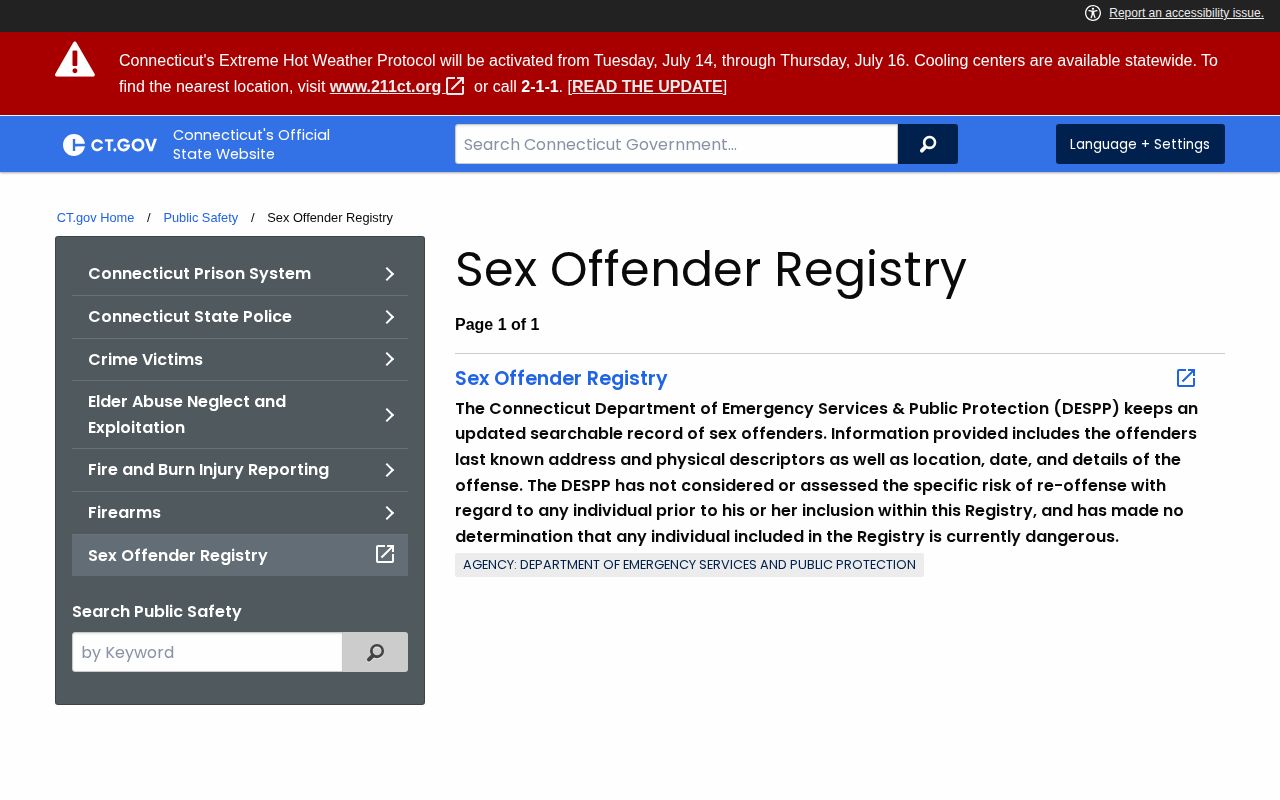
The screenshot reinforces that registry photos concern qualifying registrants, not the general population of people released after a Milford arrest.
Milford Mugshots in Court and News
The Connecticut criminal case lookup can identify a pending case, conviction, daily docket entry, sentence review matter, or arrest warrant. It normally does not supply the booking photograph. Its value is routing. Once the docket confirms the case and arresting agency, request the image from the agency that took or maintains it. A court result also helps prevent an old image from being mistaken for a current arrest.
Official agency press releases sometimes include a photograph. Reputable local news may republish that image or report an arrest. Those items are snapshots of what was reported at publication. Corrections, dismissals, erasure, sealing, and later case action can change the public record. Trace a news image back to the named agency when possible and compare it with the current court disposition. Do not treat an unlabeled copy or an old commercial entry as proof of release.
Connecticut's court site also limits older online conviction data. It generally displays convictions for no more than 10 years after sentencing, with shorter periods possible under Practice Book § 7-13, and removes entries one month before the period ends. Youthful offender, juvenile, infraction, and violation convictions are not shown. An absent old docket does not prove that the photo or arrest never existed.
Connecticut Mugshot Disclosure in Milford
Connecticut uses a cautious arrest-record framework. C.G.S. § 1-215 permits redaction of witness identities, identifying details of certain victims, information that could prejudice a pending prosecution or future law-enforcement action, and material sealed by a judicial authority. Personal possessions found at arrest are not disclosed unless relevant to the crime. These rules mean an agency may release basic arrest facts while withholding or redacting other parts of the file.
The 2014 Connecticut Supreme Court decision Commissioner of Public Safety v. Freedom of Information Commission is part of the legal background for limits on what police must disclose during a pending prosecution. The safe request position is direct and narrow: ask the agency for the named booking photograph, cite the connected incident, and let the records custodian apply current law. Do not promise that the image must be released.
No Connecticut law specifically matching other states' anti-pay-to-remove mugshot statutes was found in the Milford research. Official removal or access therefore turns on FOIA, arrest-record limits, agency publication policy, erasure, sealing, and court orders. Commercial removal services should not be treated as part of the official process.
Required use limit: This resource is not a consumer reporting agency. Mugshot information cannot be used for employment, tenant, credit, insurance, or any other FCRA-regulated screening decision.
Milford Mugshots After Erasure
Erasure and sealing change public visibility. Connecticut chapter 961a governs erasure of certain criminal records, and § 1-215 excludes erased records from its arrest-record definition. A sealing order can also restrict parts of a file. When either applies, an official image may no longer be available through the ordinary agency route even though it circulated earlier. The court clerk or records custodian must interpret the order for the specific case.
Start with the court record. Determine whether the case was dismissed, nolled, erased, sealed, modified by a pardon, or simply removed from the online display because the retention period ended. Then send the relevant order or case information to the agency that published or controls the image. An agency can address its own record and publication. It cannot force an unrelated publisher to update a separate copy.
No mugshot gallery is hosted. Official police, DOC, court, registry, and agency-release sources remain the proper places to request, verify, correct, or restrict an image. The Milford release record search provides the broader custody and disposition trail, while the Milford 24-hour release fallback explains why no local recent-release feed is available.
Note: A photo can remain online after custody ends, while an erased or sealed record may lawfully disappear from official public access.