
Milford Projected Versus Actual Release
Connecticut's official term is estimated release date. Searchers often call that a projected release date because it is the system's current calculation, not a record of an event that has already happened. CT DOC also identifies minimum release date and maximum release date fields. The minimum date reflects an earliest calculated point under the applicable sentence rules. The maximum date is the outside sentence date shown by the correctional record. The estimated date reflects the agency's current calculation after applicable factors are processed. A special parole date can mark the start of a community supervision term rather than the end of every legal obligation.
Scheduled versus actual: A projected date can change. Only the final DOC, facility, court, or release record confirms that release occurred.
Pretrial custody works differently. Connecticut holds accused people in state DOC facilities as well as sentenced people. A detainee awaiting trial has no fixed sentence-completion date. Release can depend on posting bond, a promise or order, a court discharge, a change in the case, or a later sentence. A Milford police detainee who never entered DOC may have no CT DOC result at all. For that local path, the Milford police record and Judicial Branch docket are the relevant sources.
Find a Milford Projected Release
Classify the custody system first. CT DOC is the right source for a person committed to Connecticut state custody after a Milford case. It is not the source for a police-only release or a federal sentence. The public search advises using only the inmate number or only the first few letters of the last name for better results. A DOC number is the strongest key. If only a name is known, compare date of birth and other identifying fields before relying on the record.
- Open the CT DOC inmate information search.
- Enter the inmate number alone, or use a short last-name prefix. Avoid filling extra fields at the first try.
- Match the person by name, date of birth, admission details, current location, and controlling offense.
- Read the minimum, estimated, and maximum release fields that appear, plus sentence date, special parole date, and detainer information.
- Check the Judicial Branch criminal case lookup for sentencing and later court action when the DOC calculation is unclear.
- Contact DOC Public Information for a time-sensitive conflict or a calculation that appears wrong.
The public result must be read in context. A current location can show where the person is held, but it does not prove conviction because DOC also houses accused people. A detainer is a request or hold from another authority that can affect what happens at the end of the current custody term. A special parole date concerns community supervision. For a federal Milford case, use the BOP locator instead of trying to force the name into CT DOC.
The Milford released-inmate records overview covers the separate police, state, court, federal, and immigration paths.
Milford Release Date Fields
CT DOC's Management Information Systems Unit says the public OBIS feed can include inmate number, name, birth date, latest admission date, current location, status, bond, controlling offense, sentence date, maximum sentence, maximum release date, estimated release date, special parole date, and detainer information. The DOC FAQ also identifies minimum release date, estimated release date, maximum release date, photograph, correctional history, and disciplinary history where applicable. Not every record contains every field.
| Field | How to read it |
|---|---|
| Minimum release date | An earliest calculated date under the sentence and rules shown by DOC |
| Estimated release date | DOC's current calculated date, commonly called the projected release date |
| Maximum release date | The outside sentence date reported in the correctional record |
| Special parole date | A date tied to the start of court-imposed special parole |
| Detainer | A notice or hold from another authority that may change the next custody step |
| Status and location | The current reported correctional state and facility or community context |
The CT DOC frequently asked questions identify the release-date fields available in inmate records.
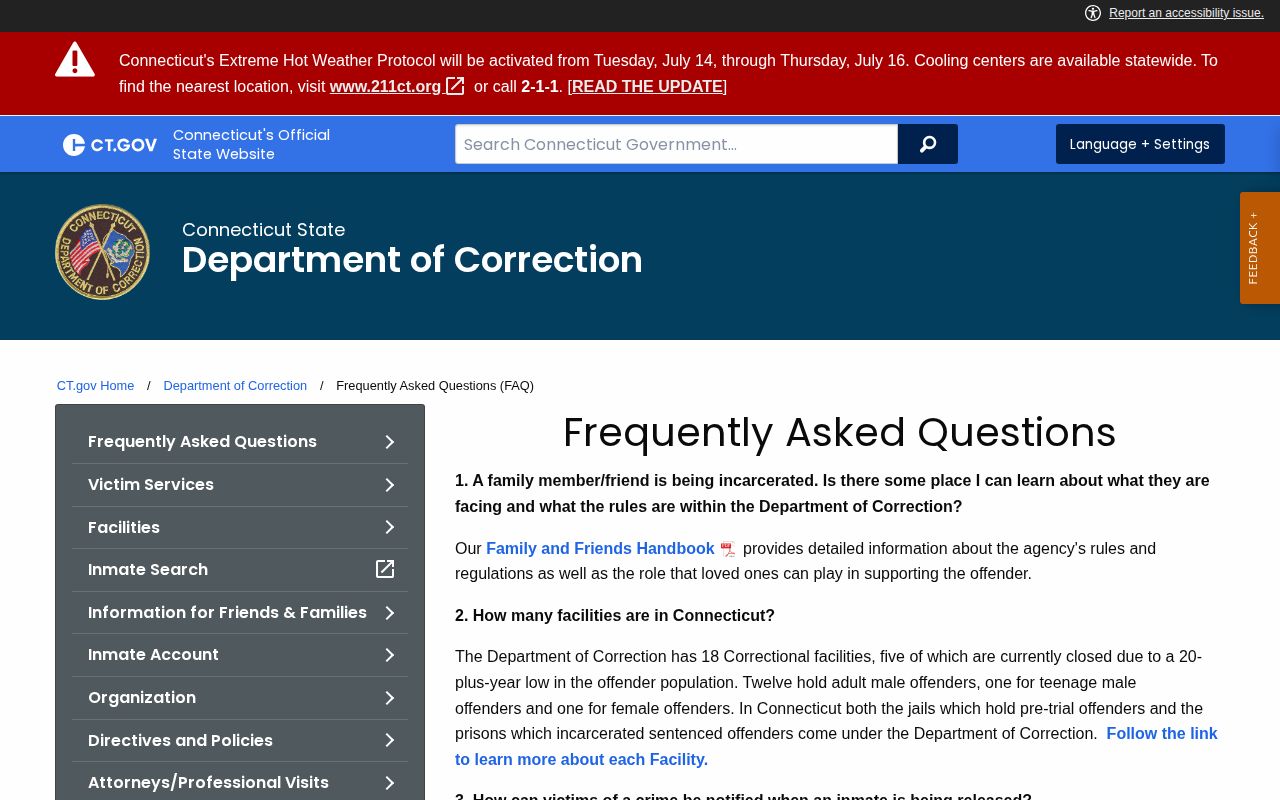
The field list helps distinguish a calculated estimated date from the maximum sentence date and from a special-parole date.
Note: A blank field may mean that it does not apply or is not publicly displayed; it does not create a release date.
Milford Release Credits and Jail Time
Connecticut General Statutes § 18-98e governs earned risk reduction credit, known as RREC. Eligible sentenced people may earn up to five days per month at the commissioner's discretion. Credit is tied to the offender accountability plan, eligible programs and activities, and good conduct. Rule obedience alone is not enough. The statute excludes listed offenses and certain persistent offenders. It also bars credits from reducing a mandatory minimum term.
Credits can be lost for misconduct, insubordination, refusal to follow recommended programs, refusal to obey institutional rules, or other good cause. DOC must review and verify the credits before a release based on them. Presentence confinement also matters. C.G.S. § 18-98d governs credit for time spent in custody before sentencing. A Milford defendant held after arrest may have that jail credit applied to the sentence calculation. When the date appears wrong, compare the court mittimus, which is the formal commitment order, with the DOC calculation.
The official earned risk reduction credit statute sets the eligibility, conduct, loss, and verification rules.
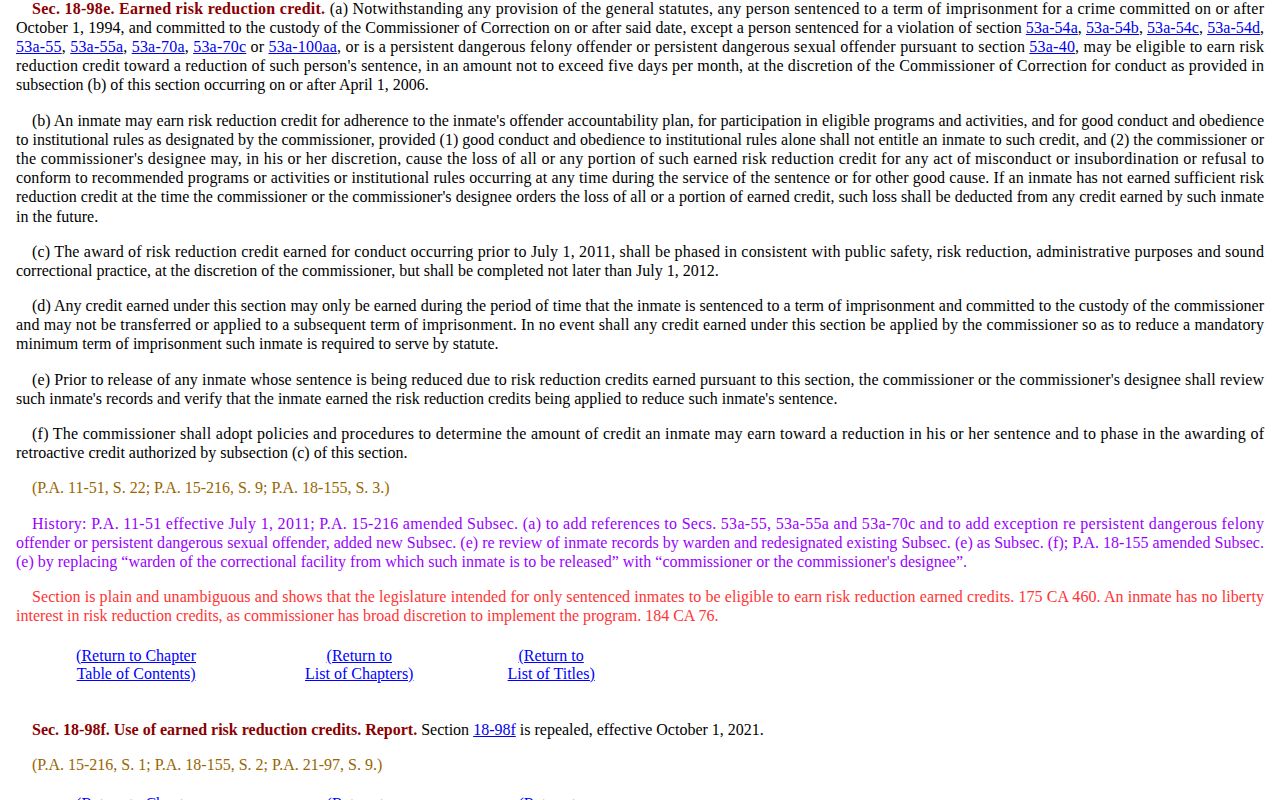
The statute shows why earned credit is conditional and why a public estimate can move after DOC verifies or removes credits.
Why Milford Release Dates Change
A projected date changes when one of the facts in the sentence calculation or release path changes. Some changes move the estimated date itself. Others leave the sentence date in place but change where the person goes next. For example, a detainer may lead to transfer to another authority. A parole grant may permit supervised community release before the maximum date. A court correction can change credited time or the sentence being served.
| Factor | Possible effect | Best confirmation |
|---|---|---|
| RREC earned or verified | May reduce the current estimate where legally allowed | CT DOC calculation and § 18-98e |
| Credit loss | May move the estimate later | DOC disciplinary and sentence record |
| Presentence credit correction | May change credited jail time | Court mittimus and DOC record |
| Detainer or hold | May cause transfer rather than community release | DOC detainer field and holding authority |
| Court order | May alter bond, sentence, or custody authority | Judicial Branch docket and clerk |
| Parole decision | May permit supervised release or leave custody unchanged | BOPP record and CT DOC status |
| Nightly data update | May delay the public screen after a real change | DOC Public Information or facility |
CT DOC warns that status may change quickly despite daily updates. The MIS Unit says the public search receives a nightly OBIS feed. That cadence makes the search a strong public record, but not a real-time gate log. Urgent plans should not rely on the displayed date alone.
Milford Parole Eligibility Dates
A parole eligibility date is not the same as the estimated release date. Eligibility means BOPP may have legal authority to consider release. Suitability means the Board decides whether release should be granted. BOPP says its general framework applies to a total effective definite sentence of at least two years and one day. Many eligible people can be considered after serving at least 50 percent of the sentence, less qualifying jail or risk reduction credits.
For offenses involving the use, attempted use, or threatened use of physical force, BOPP describes an 85 percent threshold less jail credit. For covered offenses committed on or after July 1, 2013, RREC does not reduce that 85 percent parole eligibility date. Some offenses are generally ineligible, with limited youth exceptions described in the law. Even legal eligibility does not guarantee review or release. The Board may apply policy limits based on pending charges, disciplinary placement, risk designation, or other listed conditions.
Key distinction: Eligibility opens a possible Board review; the estimated release date is DOC's current sentence calculation; neither proves an actual release.
Milford Short-Sentence Release Rules
There is no separate Milford county-jail good-time policy. Connecticut places both pretrial jails and sentenced prisons under CT DOC. That structure is crucial when a search phrase sounds local. The sentence and credit rules come from state law and DOC, even when the underlying arrest or court case began in Milford.
C.G.S. § 18-100c provides a community-program path for certain people serving definite sentences of two years or less. The statute allows release to a halfway house, group home, mental health facility, or another approved community correction program after at least one-half of the sentence, less specified credits including RREC. This is a form of supervised placement, not proof that the sentence has ended. C.G.S. § 18-100f separately addresses release of certain pretrial arrested people to an approved residence with conditions unless the court orders otherwise.
These statutes explain why leaving a facility does not always mean unconditional discharge. The status, supervision terms, and next placement matter as much as the date.
Confirm a Milford Release Date
Use the public date as a starting point. For a state sentence, CT DOC Public Information handles further offender-information questions at 860-692-7780 from 8:00 a.m. to 4:30 p.m., Monday through Friday. Mail can go to Connecticut Department of Correction, Public Information Office, 24 Wolcott Hill Road, Wethersfield, CT 06109. The MIS Unit also lists DOC.PIO@ct.gov as a public contact. A facility can address a current custody question, while the court clerk is the better source for a disputed sentence or mittimus.
CT SAVIN through VINELink can send registered notices for custody and court events. Connecticut uses separate registration paths for DOC offenders and offenders with court cases. The Milford VINELink inmate search explains that two-track registration. Alerts can help with a pending change, but the service does not replace the final release record and does not preserve notifications forever after discharge.
For a Milford police-only case, call records at 203-874-4615 or use the police public-records portal. For federal custody, use BOP. If immigration custody follows a DOC release, use ICE's detainee locator because ICE-held people are not included in the CT DOC public database. Each source answers a different custody question.
Note: Confirm the release with the agency that held the person when travel, pickup, court attendance, or another time-sensitive step depends on it.